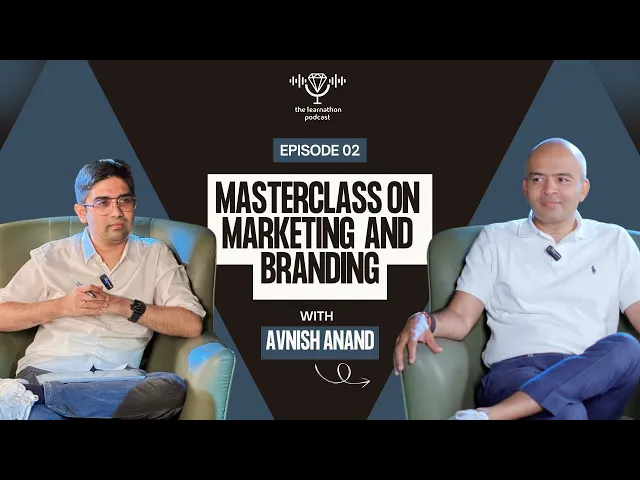

₹0 to 3k Crores: Lessons on Marketing, Branding & Customer Obsession - The Learnathon Podcast Episode 2
In Episode 2 of The Learnathon Podcast, Avnish Anand, Co-Founder of CaratLane, shares his powerful journey scaling a business from ₹0 to ₹3,000 Crore. Get deep insights into marketing strategies, building a strong brand identity, customer obsession, and practical lessons for founders and marketers. Whether you’re launching a startup or growing an established brand, this episode is filled with actionable strategies and real-world wisdom.
Watch Time :
0 hr 58 min
Date :
In this episode, we cover:
Journey from ₹0 to ₹3,000 Crore – How growth happened and core decisions made.
Marketing Fundamentals for Rapid Growth – What works in modern branding and customer reach.
Branding That Resonates – Building an identity customers remember.
Customer Obsession & Loyalty – Why obsessing over customer experience matters.
Leadership Lessons & Practical Tips – Advice for founders scaling a business.
If you aspire to build a successful jewelry brand, strong technical knowledge is essential. Explore our industry-recognized programs:
Avnish Anand is the co-founder and former CEO of CaratLane, one of India’s most successful omni-channel jewellery brands, scaled from a start-up to a multi-thousand-crore enterprise through strategic marketing, strong brand identity, and customer-obsessed growth.
He shares candid insights from his journey, covering high-impact marketing principles, brand building that resonates, and the role of customer experience in long-term business success.
This video features an interview with Avnish Anand, Co-founder and ex-CEO of CaratLane, discussing his journey with the company from its inception to becoming a multi-crore business (2:13).
Here are the key takeaways from the discussion:
Product Management: Avnish explains that product management is a function that brings together technology, data, and consumer journeys to create digital infrastructure like apps, websites, and store applications (4:36). It's crucial for any digitally enabled business to create great consumer journeys and an efficient, data-driven organization.
Generalist vs. Specialist: While specialists are essential for specific tasks like coding or design, generalists are needed to integrate different business functions and create a cohesive experience (6:10). The concept of "T-shaped people," who have deep expertise in one area and a broad understanding of others, is becoming increasingly important (7:06).
Building CaratLane from ₹0 to ₹3000 Crores:
Early Years (₹0 to ₹25 Crores): The initial focus was on individual customer acquisition due to zero brand awareness for online and studded jewelry (8:20). Avnish recounts personally engaging with customers, even visiting their homes, to build trust (10:08). Leads primarily came from Google Ads and word-of-mouth (18:04).
Growth Phase (₹25 Crores to ₹120 Crores): This period involved significant experimentation and mistakes, including failed TV campaigns, initial struggles with the "Try at Home" model, and store concepts (11:46). However, these learnings, coupled with increased general awareness about online buying and other brands entering the market, helped build trust and scale (12:32).
Scaling to ₹3000 Crores: Post-initial growth, new levers came into play, leading to profitability and further expansion (13:18).
"Try at Home" Strategy: Initially, "Try at Home" didn't work due to a lack of dedicated resources, including staff and inventory, and insufficient technological support for real-time information and bookings (13:35). Its success later came from a commitment to dedicated teams, inventory, and technology (15:01).
Digital vs. Real Inventory: CaratLane always had physical inventory for its products, not just digital renderings, ensuring authenticity, although sometimes rendering was used for better image quality due to jewelry's brilliance (16:51).
Cultural Shifts and Data-Driven Approach: As CaratLane scaled, the overall e-commerce landscape in India matured (19:49). A significant cultural change at CaratLane was the shift to a data-driven approach around 2016, where decisions were made based on clear data insights, leading to the discontinuation of ineffective strategies like print advertising (21:05).
Impact of Investments (Tiger Global & Titan): Both Tiger Global and Titan brought different but valuable perspectives to CaratLane (24:36). Titan's investment particularly helped build trust through its association with Tanishq, provided expertise in store operations, expanded their partner network, and improved credit ratings, leading to cheaper access to capital (25:47). Titan also pushed for improved gross margins (26:39).
CEO's Role: Avnish describes a CEO's day as starting with reviewing daily numbers and focusing on short-term and long-term priorities (27:36). A crucial aspect was maintaining accessibility to customers, frontline employees, and partners to stay connected to the business (28:51). A significant part of the role involved ensuring organizational alignment through one-on-one conversations and delegating tasks effectively (29:47).
Performance Marketing: While performance marketing is useful for acquiring new customers, Avnish emphasizes the greater reward of customer retention, which many companies neglect (31:55). He highlights the need to understand the customer's problems and motivations (34:55), rather than just optimizing ads. He suggests marrying the "science of performance marketing with the art of customer behavior and understanding" for greater effectiveness (35:27).
Mid-Funnel and Lower-Funnel Strategies: CaratLane focused on understanding why customers stopped their journey in the mid-funnel (e.g., concerns about quality, policies, delivery) and implemented interventions like nudging them to chat with customer service or visit a store (38:00). In the lower funnel, close to purchase, sales teams would often intervene to help with immediate needs like same-day delivery or finding the right product (39:20).
Omnichannel Approach: Avnish believes that the distinction between online and offline is blurring, and customers view it as one business. They choose their buying channel based on their requirements, whether it's the speed of online purchase or the experiential aspect of in-store shopping (40:51). Many customers start their research online and then visit a store to buy (42:23).
Jobs To Be Done (JTBD) Framework: This marketing framework suggests that people buy products not for their functional benefits, but to solve problems in their lives, seeking progress in their emotional or social state (43:15). In the context of jewelry, people give it to communicate thoughtfulness and mindfulness to the recipient (44:15).
Who is this podcast relevant for?Startup founders and business leaders focused on scaling brands with strong marketing and customer strategies.
Jewellery industry entrepreneurs and retail leaders looking for real-world insights into building and scaling omni-channel jewellery businesses.
E-commerce professionals and digital marketers seek proven tactics for brand growth and customer retention.
Aspiring founders and business students interested in leadership lessons from high-growth consumer brands.
Download our free jewelry business & design eBooks for deeper learning.
Recent Videos
LEARN FROM INDIA'S #1 JEWELRY BUSINESS EXPERTS
J K Success Stories