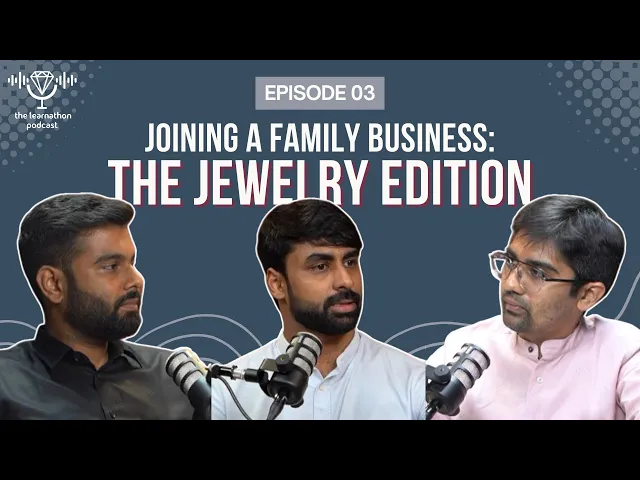

Building a Scalable Brand: Growth, Systems & Long-Term Vision - The Learnathon Podcast Episode 3
In this episode of The Learnathon Podcast, we discuss how strong systems, clear thinking, and long-term vision play a crucial role in building a scalable and sustainable brand. The conversation focuses on real-world business decisions, growth mindset, and lessons that founders can apply while scaling their startups. This episode is ideal for entrepreneurs, marketers, and builders who want to move beyond short-term wins and create lasting impact.
Watch Time :
1 hr 10 min
Date :
In this episode, we cover:
Importance of long-term thinking in business
How systems and processes help brands scale
Common mistakes founders make while growing
Decision-making during early and growth stages
Practical insights for startup and D2C founders
If you’re interested in scaling a jewelry brand, our Jewelry Design or Gemology our course can prepare you with real-world skills
Raunak Parekh and Aarj Jain are next-generation leaders in the Indian jewellery industry, representing the new wave of family-business entrepreneurs. Both are alumni of the Polished Diamond Graduate Programme at J K Diamonds Institute of Gems & Jewelry. Raunak leads Parekh Ornaments, while Aarj heads Siddhi Jewels. Building on strong family foundations, they have introduced structured systems, modern processes, and brand-driven storytelling to create scalable, future-ready jewellery businesses rooted in learning, discipline, and long-term vision.
The "How to Join & Grow Your Family Jewelry Business" podcast features Mr. Raunak Parekh and Mr. Aarj Jain, who share their experiences and strategies for success in the jewelry industry.
Key Discussion Points:
Entry into Family Business & Initial Challenges (2:00-7:57): Raunak and Aarj, both alumni of JK Diamonds Institute, discuss their individual journeys into their family businesses. Aarj emphasizes the importance of gaining external experience before joining (4:01-4:47), while Ronak highlights the initial challenges like slow decision-making, emotional influences over logic, rigid hierarchies, and outdated sales techniques (8:04-9:25).
Cultural Differences and Centralized Face Value (7:58-11:34): They address the "cultural shock" of new generations entering traditional family businesses and the challenge of shifting from a centralized "face value" (owner's reputation) to a strong "brand value" (10:22-11:34). They aim for the brand to speak for itself, like larger corporations.
B2B vs. B2C Customer Mindset (11:35-13:57): Aarj explains the difference in approach for B2B customers, where there's more opportunity to present new ideas and get feedback, compared to B2C where the customer often seeks the established "face" of the business.
Best Ways to Enter a Family Business (13:58-20:46): Aarj suggests starting with what you're confident in, such as sales and marketing, to gain initial wins and build confidence (15:41-17:29). Ronak also confirms that he started by focusing on marketing and sales to streamline operations (19:57-20:17). The idea of taking control of marketing independently before integrating it into the main business is also discussed (19:35-19:56).
Major Challenges in Recent Years (20:47-25:18): A significant challenge is the changing customer mindset. The new generation wants a story and emotion attached to products, not just technical details (22:26-23:00). They are also impatient and do extensive online research before visiting stores (23:00-24:00, 24:32-25:09).
Storytelling Techniques for B2B Success (25:19-29:05): Aarj emphasizes making it easier for B2B customers to sell to their own customers by providing compelling storytelling for collections (25:25-26:11).
Business Pillars for Scaling (29:06-35:01): Ronak details the pillars that helped them scale, including analyzing product performance, customer relationship management, merchandising, and crucial sales team training (29:30-31:00). They also highlight the importance of transparency and continuous improvement (31:32-31:56).
Most Challenging Departments & Handling Them (35:02-40:10): Ronak identifies HR/recruitment (finding loyal and skilled team members) and the purchase department (sourcing new and updated products) as the most challenging (35:36-36:32). He stresses the importance of investing in the team as much as in clients (37:47-37:55).
Importance of Data in Business (40:11-42:19): Aarj emphasizes using historical sales data to understand product performance, peak sales months, and regional preferences (40:11-41:44). He highlights how having an ERP system for digital data for over 12 years has been a significant advantage (41:02-41:17).
Automating Owner-Driven Departments (47:52-52:32, 54:35-58:50): Both Raunak and Aarj discuss the process of shifting from owner-driven departments to professionally run systems. This takes time, typically 5 to 7 years, but ultimately allows the family members to focus on expansion and other strategic goals (38:29-38:46, 54:35-58:50).
Who is this podcast relevant for?Jewellery Entrepreneurs and Business Owners looking to build or scale their brands with modern growth systems.
Family Business Successors and Next-Gen Leaders navigating generational transition and strategic modernization
Startup Founders and D2C Brand Builders focused on long-term vision, operational excellence, and scaling frameworks.
Marketers and Business Strategists seeking real-world examples of system-driven brand growth in traditional industries.
Download our free jewelry business & design eBooks for deeper learning.
Recent Videos
LEARN FROM INDIA'S #1 JEWELRY BUSINESS EXPERTS
J K Success Stories