

A Buried Treasure on the Ancient Pilgrimage Road
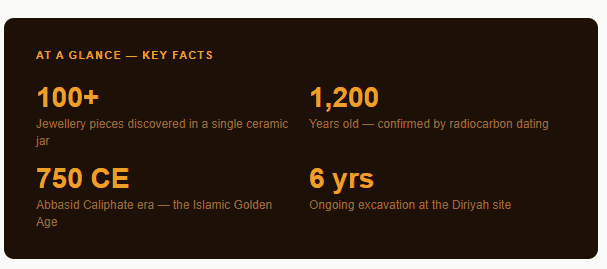
The treasure — now officially named the Diriyah Treasure — dates back to the early Abbasid Caliphate period, placing it firmly in the 8th to 9th century CE, over 1,200 years ago. Radiocarbon analysis of organic remains from the site confirmed this dating, making it one of the oldest and most complete jewellery hoards ever found in the Arabian Peninsula.
Diriyah, located southwest of Al-Qassim among mountains and valleys, was no ordinary settlement. During the Abbasid period, it served as a vital stopover along the Basran Hajj route — the ancient pilgrimage road connecting Basra in southern Iraq to the holy city of Mecca. Thousands of pilgrims, traders, and travellers passed through this very spot each year, making it a hub of commerce, culture, and craft.
"This discovery at Diriyah reflects the abundance of the Kingdom's cultural heritage and its longstanding role as a crossroads of trade routes and cultural exchange."
— Dr. Jasir Suliman Alherbish, CEO, Saudi Heritage Commission
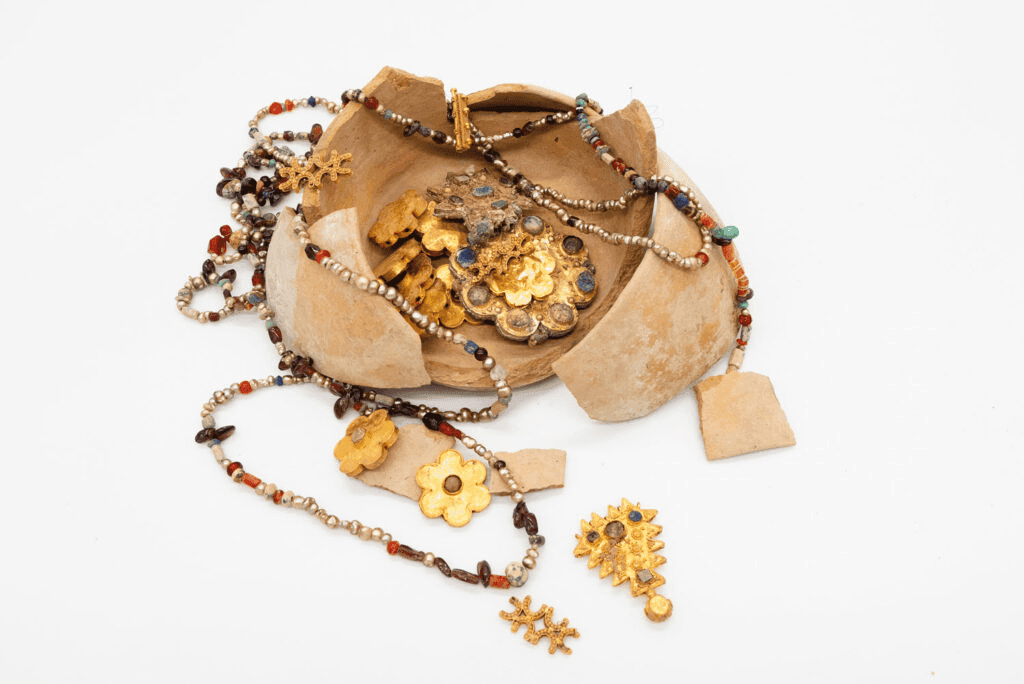
Inside the Jar — What Was Found
What archaeologists found inside was extraordinary — not a scattered collection of random artefacts, but what appears to be a complete, carefully assembled jewellery set, preserved in remarkable condition despite being buried for over a millennium.
The Collection Includes:
(A) Floral Pendants
Multi-petalled flower designs with coloured gemstones set within finely crafted gold frames.
(B) A Grand Disc Ornament
A large circular centrepiece inlaid with coloured stones arranged in perfect symmetry around a central pattern.
(C) Multi-Coloured Gemstone Beads
Vivid beads of varying colours, believed to have been strung together as a ceremonial necklace.
(D) Delicate Gold Spacers
Tiny, intricately made gold connectors that would have linked each piece of the set together.
(E) Silver Components
Additional silver elements forming part of the broader adornment set.
The Craftsmanship — Ahead of Its Time
For those who study jewellery making, the Diriyah Treasure offers a rare and vivid window into the goldsmithing traditions of the Abbasid era.
Three Principal Techniques Have Been Identified in the Collection:
1. Gold Sheet Hammering and Embossing
Thin sheets of gold were beaten and shaped entirely by hand, then pressed to create raised, three-dimensional decorative patterns on the surface of each piece.
2. Bezel-Style Stone Inlay
Semi-precious gemstones were carefully fitted into handcrafted gold frames, a technique closely related to what jewellers today call bezel setting. Each stone was placed with precision to achieve geometric symmetry.
3. Floral and Geometric Motifs
The design language of the pieces draws on a rich blend of Persian, Byzantine, Mesopotamian, and Arabian artistic traditions — a reflection of the Abbasid Empire's vast geographic reach and its role as a meeting point of civilisations.
These are not primitive techniques. They are the foundational vocabulary of fine jewellery making — At JK Diamonds Institute of Gems & Jewelry, these fundamental principles continue to be taught through the Gemology Course and Manual Jewelry Designing Course.
The Unsolved Mystery — Who Left It Behind?
Researchers from the Saudi Heritage Commission believe the hoard may have been hidden by a traveller or pilgrim passing through Diriyah along the Hajj route — possibly buried for safekeeping with the intention of returning to retrieve it. But whoever buried it never came back.
Was it a wealthy merchant caught in conflict? A noble pilgrim taken ill on the road to Mecca? A family hiding its fortune during a time of uncertainty?
The sealed jar offers no answers.
It simply waited — for 1,200 years — until the archaeologists arrived.
What we know for certain is this: the person who owned this collection had extraordinary taste, considerable resources, and access to some of the finest goldsmiths of the medieval Islamic world.
A Note from J K Diamonds Institute
The techniques found in the Diriyah Treasure — gold hammering, bezel stone setting, floral and geometric design — are the very foundations of the jewellery craft we teach every day.
Discoveries like this remind us that jewellery has never been merely decorative. It is the most personal record of human skill, culture, and creativity that time can preserve.
At J K Diamonds Institute of Gems & Jewellery, we believe that understanding where this craft comes from is inseparable from learning to practice it well.
Author