


A 162-year-old Mumbai legacy brand just got a new owner — and it's one of the biggest jewellery M&A moves India has seen in years.
If you've been following jewellery business news this week, you've probably seen the headline everywhere: GRT Jewellers is acquiring a 74.12% stake in Tribhovandas Bhimji Zaveri (TBZ) for up to ₹1,033.71 crore. For an industry that rarely sees this scale of consolidation, this is a big deal — literally and figuratively.
Here's everything you need to know, broken down simply.
What Exactly Happened?
Chennai-based GRT Jewellers India has signed a Share Purchase Agreement (SPA) with the promoters of Tribhovandas Bhimji Zaveri Ltd (TBZ) — popularly known as TBZ The Original — to acquire a majority stake in the company.
The numbers at a glance:
Stake being acquired: 74.12% (4,94,59,775 shares) from TBZ's promoters
Deal value: Up to ₹1,033.71 crore, at a maximum of ₹209 per share
Deal signed: August 31, 2026
TBZ's market cap at the time: ₹2,038 crore
GRT's founding year: 1964 (Chennai)
TBZ's founding year: 1864 (Mumbai)
As per SEBI regulations, GRT has also announced a mandatory open offer for an additional ~25.88% (up to 1,72,70,845 shares) from TBZ's public shareholders, at ₹249.61 per share — an offer size of up to ₹431.09 crore. Interestingly, this open offer price was about 18% below TBZ's prevailing market price at the time, which didn't stop the stock from rallying anyway.
The deal isn't final yet — it's still subject to regulatory clearances, including approval from the Competition Commission of India (CCI) and the company's lenders, along with other customary closing conditions.
Who Is GRT Jewellers?

Founded in Chennai in 1964 by G. Rajendran, GRT Jewellers has grown into one of South India's most trusted jewellery names. Today, it runs 68 stores across India and one in Singapore, with a workforce of over 12,000 employees.
Until now, GRT has largely been a private, South-India-anchored player. This acquisition is its first move into a listed jewellery business — a strategic shift that gives it a national platform overnight.
Who Is TBZ, and Why Does It Matter?
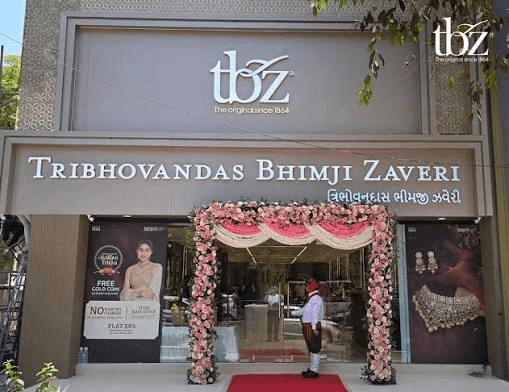
Tribhovandas Bhimji Zaveri was founded in 1864 in Zaveri Bazaar, Mumbai — making it one of the oldest continuously running jewellery houses in the country. TBZ was also a pioneer in several firsts for Indian jewellery retail:
India's first brand to popularise lightweight precious jewellery
First to offer lifetime buyback on gold and diamond jewellery
First to introduce 100% BIS hallmarked 22-karat gold jewellery
First to offer certified solitaire diamonds
With 37 stores spread across the country, TBZ brings GRT a ready-made national footprint — something that would have taken years to build organically.
Why Is This Deal Happening Now?
This is the question everyone's asking, and the timing tells its own story.
1. Gold prices are at record highs. Rising input costs are forcing jewellery retailers to rethink expansion — and consolidation (buying an existing network) is often cheaper and faster than opening new stores from scratch.
2. Lightweight jewellery is the new growth driver. As gold gets pricier, Indian buyers are shifting toward lighter, more affordable designs — a trend both GRT and TBZ are well positioned to ride together.
3. Organised retail is winning. India's jewellery market is steadily shifting from unorganised, local jewellers to branded, trust-driven retail chains — and scale matters more than ever in that race
What Does GRT Get Out of This?
In simple terms: Instant pan-India presence.
GRT's Managing Director, G.R. Ananthapadmanabhan, called the acquisition a fit with the company's strategy of "spreading our presence across India," while co-MD G.R. Radhakrishnan described the deal as "truly transformative" for GRT's long-term ambitions of building a meaningful national footprint.
Rather than spending years and crores opening new showrooms city by city, GRT now inherits:
37 ready TBZ stores across multiple states
An established, recognisable heritage brand
An existing customer base built over 16 decades
How Did the Market React?
Strongly. TBZ shares surged 20% to hit their upper circuit at ₹366.50 on the BSE the day after the announcement — a fresh 52-week high — with trading volumes jumping more than 6.7 times the usual. Over six months, the stock has now risen nearly 149%, making it one of the standout "multibagger" stories in the sector this year. That's notable because it happened despite the open offer price being set below the stock's market price — investors were clearly betting on GRT's ownership being a long-term positive for TBZ, not just reacting to the offer price itself.
What Happens to TBZ Now?
For now, TBZ continues to operate under its own name — this is a change in ownership, not a shutdown or rebrand. Outgoing TBZ Chairman and Managing Director Shrikant Zaveri has expressed confidence that the brand's future is secure under GRT's leadership. The deal is still subject to regulatory approvals and standard closing conditions, so it isn't final yet.
What's likely next:
CCI and lenders' approvals
Completion of the open offer process for the remaining public stake
Possible operational integration between GRT and TBZ over time
For students, professionals, and gemology enthusiasts tracking the business side of the jewellery world, this is a textbook case of how brand legacy, retail scale, and market timing come together in a major M&A move — and it's a space worth watching closely as the deal moves through its remaining approvals.
Author


Sep 15, 2026
Uncategory

Sep 10, 2026
Uncategory

Jul 9, 2026
Uncategory


