

The Self-Purchasing Woman Is Rewriting Diamond Demand
Date :
Read Min :

No wedding. No proposal. No festival on the calendar. Just her, a random weekday, and a diamond she picked out for herself because she wanted to.
Ten years ago, that would've raised eyebrows. In 2026, the industry's got a name for it — self-gifting — and the numbers say this isn't a small "girlboss" moment. It's women rewriting who the diamond industry sells to, why they buy, and what they expect in return.
India's Self-Purchase Diamond Market in 2025
India is now the world's second-largest diamond jewellery market, holding close to 12% of global demand (De Beers India Diamond Acquisition Study, 2025).
The market is projected to almost triple by 2030 — from roughly ₹49,700 crore to ₹1.5 lakh crore.
64% of natural diamonds bought outside weddings in India are bought by women, for themselves.
Even within weddings, 79% of bridal jewellery spend is the bride's own money — not her family's.
Diamond daily wear has jumped from 27% in 2014 to 52% today.
Gen Z alone drives 51% of the market's total value.
She Doesn't Need a Proposal to Buy a Diamond
Earlier, a diamond used to need someone else's green light — a ring, a wedding date, a festival already circled on the calendar. It belonged to someone else's story, and she just happened to be standing in it.
Those days are gone. Now the reason lives inside her own timeline: a promotion, a first real paycheck, a business she finally launched, a degree she finished while working full-time. None of these used to count as "diamond-worthy." Now they're exactly the trigger. She's not waiting on a man, a wedding, or a festival to tell her when she's allowed to celebrate herself.
Locker Luxury Is Fading Away
For decades, a diamond's real home was a bank locker — pulled out for one wedding, one photo, and put right back until the next function. It was luxury that existed to be owned, not worn.
That era is quietly ending. Daily wear jumping from 27% to 52% means more than half of all diamond purchases today are for pieces meant to live on her hand, not in a vault. If she bought it with her own money, she's not saving it — she's wearing it to work, to the gym, on a flight, on a completely ordinary Tuesday. And this shift is reshaping the product itself: lower-set stones that won't snag through a normal day, tougher everyday metals, and smaller, more wearable cuts winning out over the big, showy pieces built to perform for one event and then disappear for a year.
For eg: Sania Mirza has long worn her signature diamond studs and nose ring on court, match after match — not jewellery for one photo, but jewellery built to move with her.

Tanishq's own "Every Woman a Diamond" campaign makes the same point outside sport — featuring real women like Jaclyn DMello, an Indian airline pilot, and Ishani Jamwal, a mountaineer and skier, wearing their diamonds through work and adventure, not just weddings.
Diamonds Are Becoming a Love Language, Not Just a Wedding Ritual
Here's the part that's genuinely new: the diamond isn't just moving from her family to her anymore — it's moving from her, outward, as a gesture.
Daughters with their own income are buying diamonds for their mothers, no function required — a quiet "thank you for everything" that doesn't need a wedding to justify it. Women are buying pieces for sisters, best friends, and partners too, simply as an expression of love or gratitude, on no particular date. And in a genuinely new twist, some women are buying engagement rings for their partners — flipping a tradition that used to run only one way. The diamond is turning into something closer to a personal love language than a ritual object tied to one specific relationship or occasion.
She Researches Like a Buyer, Not a Bride
This is the point that changes everything else about how diamonds get sold: she is not walking in uninformed.
By the time she reaches the counter, she has usually already compared cuts and prices across multiple websites, understood the real difference between lab-grown and natural diamonds, used a brand's live chat or virtual consultation to ask pointed questions in advance, and arrived with a specific budget already fixed in her head — not a vague upper limit, an actual number. This means the old sales script — built on emotion, trust, and a bit of pressure — simply doesn't work on her. "Trust me, you'll love it" was a line built for someone buying on someone else's behalf. She's buying for herself, so she wants the certificate, the comparison, and the honest answer — not the charm offensive.
Everyday Shine Is Beating Wedding-Day Size
A gifted diamond only had one job: look enormous in one wedding photograph. Hers has a harder job — it has to look good every single day, under office lighting, on a video call, in a mirror selfie, not just under a golden-hour filter designed for one event.
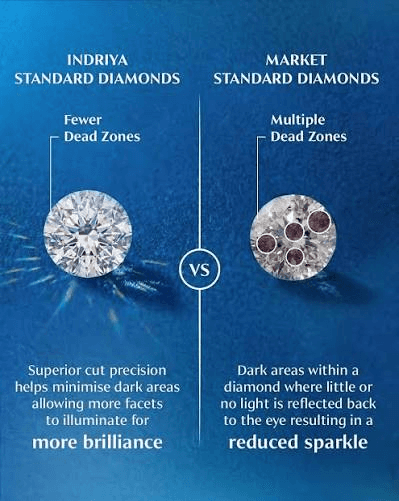
That's why cut is quietly overtaking carat as her top priority. A diamond that photographs beautifully once but looks dull under a desk lamp isn't solving her actual problem. She wants brilliance that holds up in real light, day after day — which is a completely different design and marketing brief than the one the industry has run on for decades.
Brands are already optimising for exactly this. Indriya, the Aditya Birla Group's jewellery brand, recently launched a "Sparkle Benchmark" that judges diamonds on brilliance, fire and scintillation — how well a stone actually performs in real light — instead of the standard 4Cs alone; only 1 in 5 diamonds it evaluates make the cut. Tanishq has taken a similar route with its lightweight diamond collections, built to stay wearable and sparkly through an entire day rather than just one event.
What Brands Need to Understand About Her in 2026
Market to "I earned this" moments, not just weddings and festivals.
Design locker-less by default — pieces that survive her real, daily life.
Widen the gifting story beyond weddings — mothers, friends, partners, and herself all count now.
Skip the pressure tactics. She's done her homework — be honest, not pushy.
The diamond's the same. The woman deciding to buy it isn't — and that's the whole story.the whole story.
Want to Sell to Her, Not Just Read About Her?
Knowing this shift is happening is one thing. Knowing how to price, design and sell for it is another — and that's exactly what the Diamond Business Mastermind Programme at JK is built to teach. It's less about diamonds as stones, more about how buyers like her are changing — and how to stay ahead of that instead of catching up two years late.
FAQs
What percentage of diamonds in India are bought by women for themselves? 64% of natural diamonds bought outside weddings in India are bought by women for their own use.
Is Gen Z really driving diamond demand in India? Yes — Gen Z accounts for 51% of the total value of India's diamond jewellery market, the largest share of any demographic.
Are brides also self-purchasing their jewellery? Yes. Even within weddings, 79% of what brides spend on their own jewellery is their own money, not funded by family.
What does "locker-less" jewellery mean? It means pieces designed and bought for everyday wear, not storage. Daily diamond wear in India has grown from 27% in 2014 to 52% today.
What is "self-gifting" in the jewellery industry? Self-gifting is the 2026 term for women buying diamond jewellery for their own milestones — a raise, a business launch, a birthday — instead of waiting for a traditional occasion.
Sources
De Beers: Gen Z, Self-Purchasing Women Drive India to Become Second-Largest Diamond Market — The Retail Jeweller India
Natural Diamond Ownership Among Indian Women Rises to 15% — Solitaire, GJEPC
The Rise of the Empowered Jewelry Shopper: Ritani's Data Reveals New Buying Behaviors — ACCESS Newswire
Daily Wear Diamond Jewellery for Work — Tanishq
Recent Blog
J K Success Stories